
Last Updated:
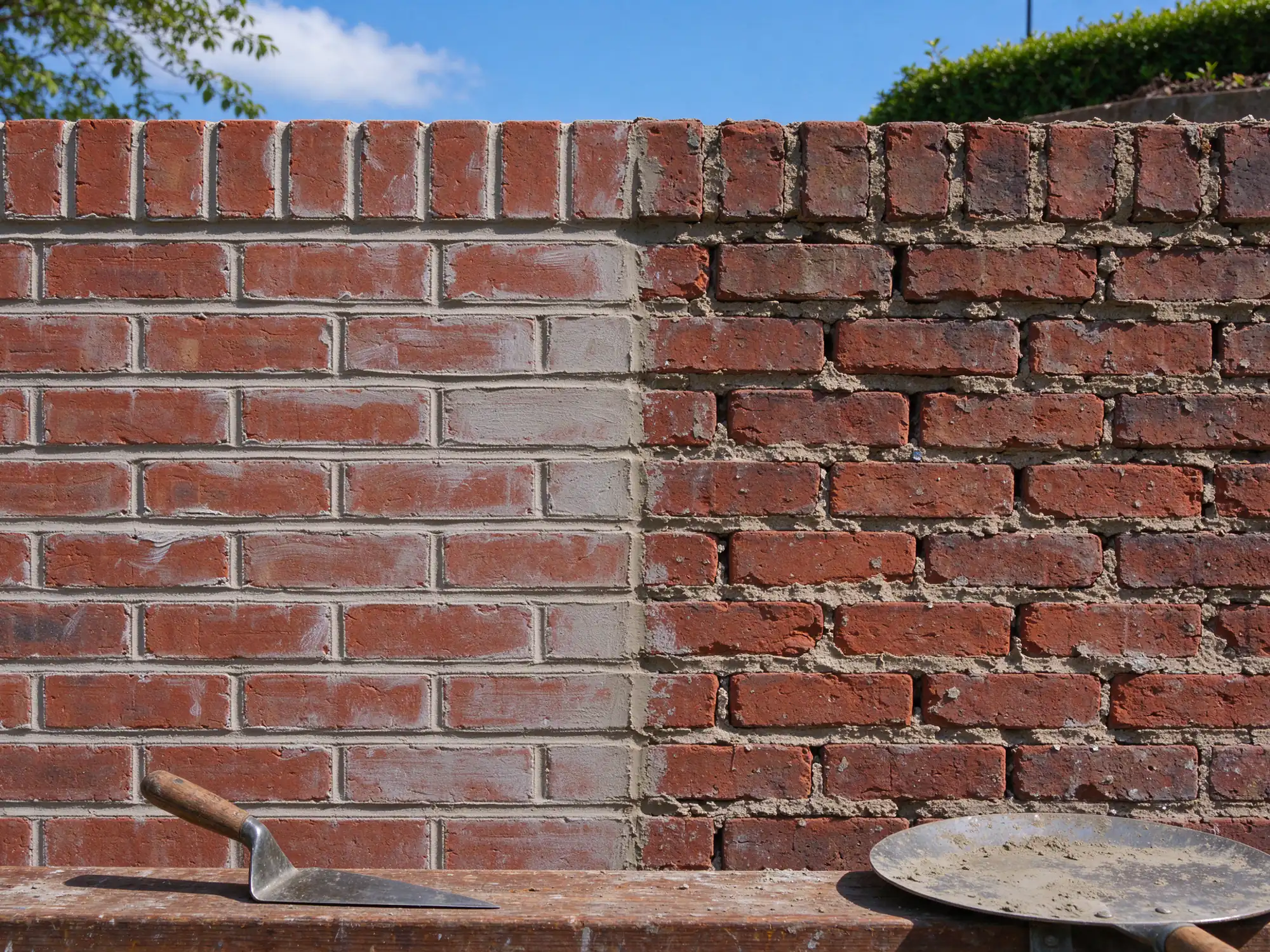
Brick pointing in Newark, NJ means cutting failed mortar out of the joints and packing new mortar back in, deep enough and soft enough to work with the brick that is already there. True Course Masonry Newark repoints brick walls across Newark and Essex County, from rowhouse fronts and three-family side walls to garden walls and the base of a stoop. The work is carried out by licensed and insured contractors. A pointed joint does two jobs: it sheds water off the face of the wall, and it acts as the sacrificial part of the wall, wearing away so the brick does not have to. When joints recede, crack or turn to sand, both jobs stop, and the brick starts taking water and stress it was never meant to carry. If you are still deciding whether your joints are at that point, the guide on when to repoint brick walks through the signs.
What happens on the first visit
A first visit is about finding out why the joints failed, not only where. That changes the scope more than wall area does. The visit checks:
- How deep the damage runs. Whether mortar is eroded at the surface or soft well back into the joint, which sets how much cutting the work needs.
- The brick itself. Whether faces are sound, spalling or already cut by an earlier grinder, and how soft the brick is compared with the mortar in it.
- Earlier repairs. Hard gray cement smeared over old joints, or shallow pointing that has already let go.
- Water sources. Gutters, downspouts, parapet caps, window sills and the joint where a stoop meets the wall, because pointing below a steady leak only buys time.
- Movement clues. Cracks that run through brick, steps in the bed joints, gaps around windows, or a wall that is out of plane. Those point to a different repair, and cracks over windows bring the steel lintel into the picture (see cracks above windows in brick).
- Access. Wall height, whether a ladder, pipe scaffold or lift is needed, and how close the neighboring house sits.
If the cracks or a bulge suggest movement rather than worn mortar, pointing alone is not the answer, and the masonry damage assessment can help you sort out what you are looking at before anyone visits. Please do not lean on or probe brick that looks loose.
Why mortar joints fail on Newark walls
Three forces do most of the damage here: water, freezing and earlier repairs made with the wrong mortar.
Water first. NOAA’s 1991 to 2020 climate normals for Newark Liberty International Airport put annual precipitation at about 46.6 inches, with 76 days a year bringing a tenth of an inch or more. Brick is not waterproof. It absorbs water, and the joints are where water gets in most easily once they open up. Walls under a failed gutter or below a parapet cap stay wet for days after each storm, which is why joint damage is often worst in a band rather than evenly across a wall.
Then freezing. The same NOAA normals show about 80 nights a year at or below 32 degrees F, and about 65 of those days warm back above freezing in the afternoon. That is a rough proxy for freeze-thaw days, not a measured cycle count. Each time water in a saturated joint freezes it expands, and a joint that is already soft loses a little more. Mortar that crumbles with a key, or sand on the sill under a wall, is that process at work.
Then the wrong repair. U.S. Census Bureau American Community Survey figures show about 24 percent of Newark’s housing units were built in 1939 or earlier, and about 43 percent before 1960. Where a wall dates from that era, it may have been laid in a lime-rich mortar that is softer than modern cement mortars. Repointing that wall with a hard, cement-heavy mix reverses the relationship: the joint becomes harder and less permeable than the brick, so water and salts leave through the brick face instead, and the face starts to pop off. If you see faces coming off bricks right next to hard gray joints, the guide on why brick spalls explains the mechanism, and the guide to lime mortar vs portland cement covers how a repair mix is chosen.
White salt deposits on brick are a related signal. Efflorescence on brick shows that water is moving through the wall and carrying salts, which is worth tracing, but it is not by itself a sign the wall is failing structurally.
How cutting out and repacking actually works
Repointing is not a skim coat over old joints. National Park Service Preservation Brief 2 recommends removing old mortar to a depth of at least 2 to 2.5 times the width of the joint, which for most brick works out to roughly half an inch to an inch, and removing any loose mortar beyond that. Mortar pushed into a shallow scratch has nothing to grip, and shallow repairs like that tend to debond and fall out in strips.
Cutting. Hand chisels are the gentlest tool on soft brick. Grinders and saws are faster, and Preservation Brief 2 notes they can be used with control on wide horizontal joints in hard cement mortar, but on thin joints in soft brick they tend to chip the edges and overcut the head joints. Homeowners report masons widening joints and cutting into brick during tuckpointing; once a brick edge is ground away, the wider joint is permanent. A scope should say which tools are used on which joints.
Dust control. Cutting mortar and brick releases respirable crystalline silica. Dust shrouds with vacuum extraction, misting and respiratory protection belong in the plan, along with closed windows and covered vents on your house and the one next door.
Mixing and filling. The mortar is chosen for the brick, the exposure and the wall, not by picking the strongest bag. Joints are cleaned and dampened so dry brick does not pull water out of fresh mortar. Deep joints are filled in layers of about a quarter inch, each pressed in and left to firm up to thumbprint hardness before the next, which limits shrinkage cracking.
Tooling and curing. The last layer is tooled to match the existing profile: concave, flush, raked or struck. A mismatched profile reads as a patch from the street even when the color is right. Fresh joints then need protection while they cure. NOAA counts about 28 days a year at 90 degrees F or hotter in Newark, and Preservation Brief 2 advises working in shade and keeping walls within about 40 to 95 degrees F, so summer pointing on a sun-facing wall needs shading and misting, and late fall work needs a frost plan. The guide to masonry work in cold weather has more on timing.
Tuckpointing, repointing and smear-pointing
The words get used loosely. Repointing is the general term for replacing mortar in existing joints. Tuckpointing, strictly, is a decorative technique: joints are filled with mortar colored to match the brick, then a thin ribbon of contrasting mortar is laid on top to make the joints look fine and crisp. In everyday use, many people say tuckpointing when they mean repointing. The tuckpointing vs repointing guide covers the history. Smear-pointing, also called buttering or skimming, is spreading mortar over worn joints and the brick edges without cutting out. It looks finished for a season, hides the joint lines, and is not proper repointing.
On a historic front, matching the joint profile and the mortar color can matter as much as the mix. The guide to matching mortar and brick explains why a cured trial area beats a color chart, and street-facing work on older buildings may fit better under historic masonry restoration.
Permits and historic districts in Newark
New Jersey’s Uniform Construction Code, N.J.A.C. 5:23-2.14, makes it unlawful to repair, renovate or alter a structure without first obtaining the required permit, with exceptions for ordinary maintenance, minor work and emergency work. The ordinary maintenance list in N.J.A.C. 5:23-2.7 is explicitly not all-inclusive and does not mention repointing or other masonry work, and it excludes anything affecting structural safety. Whether a given pointing job needs a permit is therefore a question to put to the Newark construction office before work starts, not something to assume either way. Our guide to masonry permits in Newark covers what to ask and what the office will want to know.
Historic status adds a second layer. Newark’s Landmarks and Historic Preservation regulations (Chapter 41:10, adopted 2023) give the Landmarks and Historic Preservation Commission the power to issue Certificates of Appropriateness for work in historic districts and on landmarks, and a Historic Preservation Officer may issue a Certificate of No Effect for work judged not detrimental. Street-facing work in a historic district can need commission review, and which masonry tasks are exempt has not been confirmed, so plan for the question. Districts such as Forest Hill, James Street Commons, Lincoln Park and North Broad Street contain many brick and brownstone fronts where mortar color and joint profile are visible from the sidewalk.
Where scaffolding must sit over a public sidewalk, N.J.A.C. 5:23-2.34 requires sidewalk or street bridging designed by a design professional before work that could threaten the right of way. On tight blocks, such as parts of the Ironbound where houses stand close together, access planning can be as much of the job as the pointing.
What brick pointing costs in the Newark area
National cost guides put brick repointing at roughly $3 to $20 per square foot on walls reachable without scaffolding, according to HomeGuide’s February 2026 figures, rising to around $25 per square foot on taller walls that need scaffolding. These are national budgeting ranges, not local rates or a quote. A Newark price comes from a site visit and moves with:
- the share of joints that actually need cutting out
- joint depth and how hard the old mortar is to remove
- brick fragility and how carefully cutting has to go
- wall height, scaffold and sidewalk protection
- mortar matching, trial areas and any historic review
- the number of windows, corners and other details to work around
The brick pointing cost guide breaks down each factor with worked, clearly illustrative budgets, and the masonry cost estimator gives a rough range for your own wall. If the faces of some bricks are gone, the job may combine pointing with brick repair and replacement; if the worn joints are on a chimney stack, start with chimney masonry repair. The list below shows what a pointing scope from True Course Masonry Newark covers.
What's included
- A look at the joints, the brick faces and the likely water sources before any cutting is priced
- A written scope that names the wall areas, the approximate share of joints to be cut out and how access will work
- Protection for windows, sills, plantings, paving and neighboring property next to the work
- Removal of deteriorated mortar to sound material with dust control during cutting
- A repointing mortar selected for the brick and exposure, with a trial area where color or profile matters
- Joints filled in layers, tooled to match the existing profile and cured with protection from weather
- Cleanup of mortar residue with a method suited to the brick, and a final walk of the finished joints
Pointing compared with a sealer or coating and with a rebuild
| Repointing | Sealer or surface coating | Partial rebuild | |
|---|---|---|---|
| What it does | Replaces failed mortar in the joints so the wall sheds water and the joint takes the wear again | Changes how the face absorbs water; does not replace missing or loose mortar | Takes down and relays a section of brick, usually with new mortar throughout |
| When it fits | Mortar is eroded, cracked or loose while the brick and the wall plane are sound | Rarely as a first step on old brick; only after joints, flashing and openings are dealt with and the coating suits the wall | Brick is loose, the section has moved out of plane, or units are too damaged to keep |
| What it will not do | Will not stop movement, fix a failed lintel or replace missing flashing | Will not fill open joints, and an impermeable coating can trap moisture in soft brick | Will not address the cause of movement unless that cause is also repaired |
| Effect on old brick | Compatible mortar lets the joint, not the brick, take the stress | Can hold water and salts behind the face, which feeds spalling | New brick and mortar must be matched to what stays in the wall |
Related resources
- LearnWhat Is the Difference Between Tuckpointing and Repointing?
- LearnWhen Does Brick Need Repointing?
- Decision GuideLime Mortar or Portland Cement: Which Is Right for an Old Brick Wall?
- LearnCan Masonry Work Be Done in Cold Weather?
- Cost GuideHow Much Does Brick Pointing Cost in Newark, NJ?
Representative photos of this work
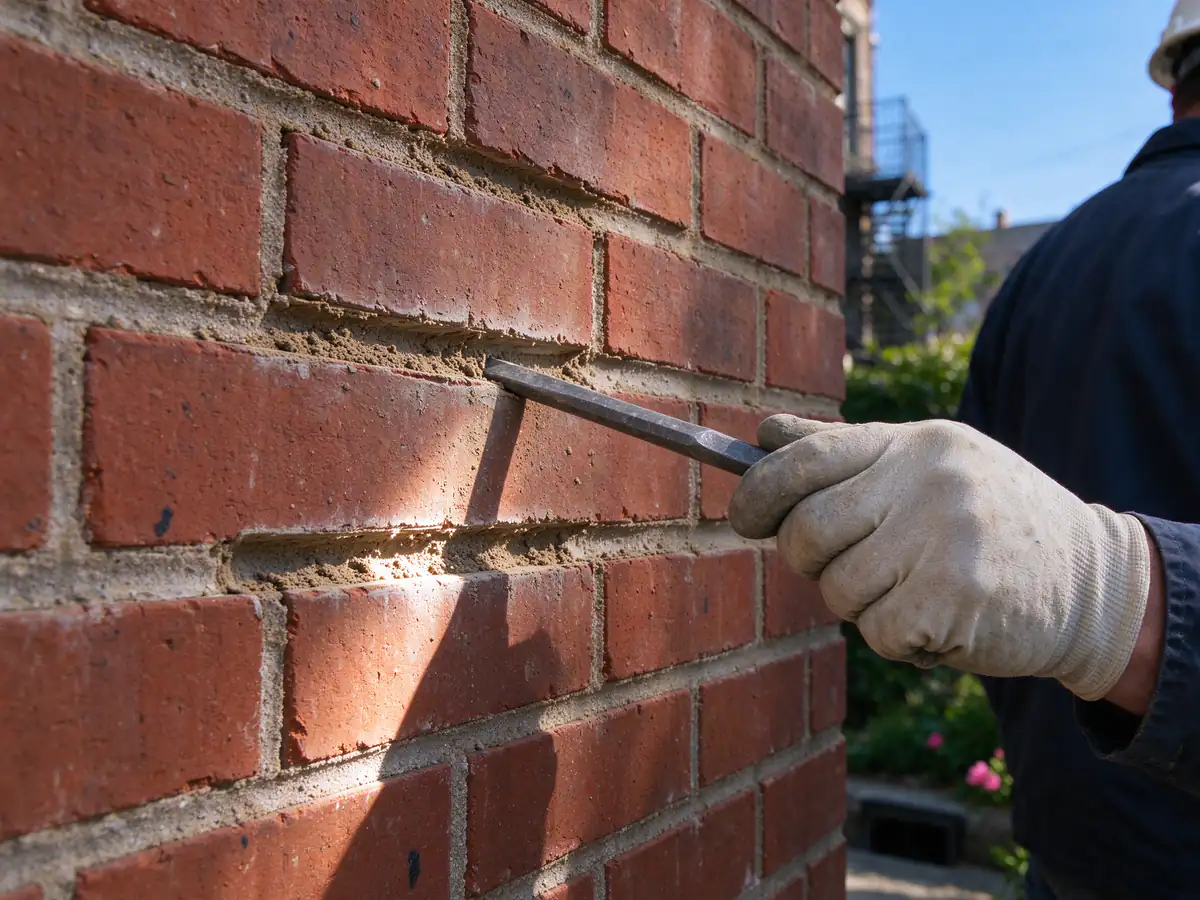
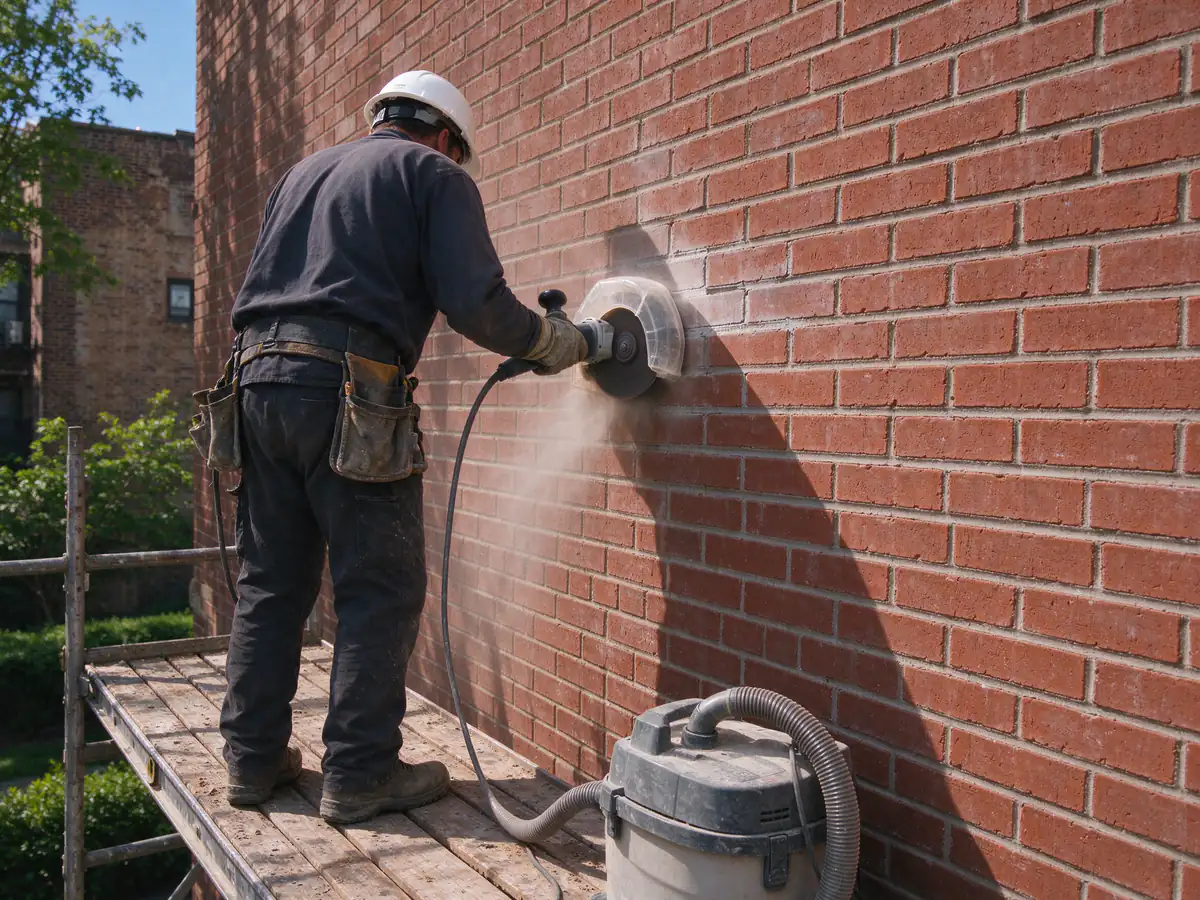
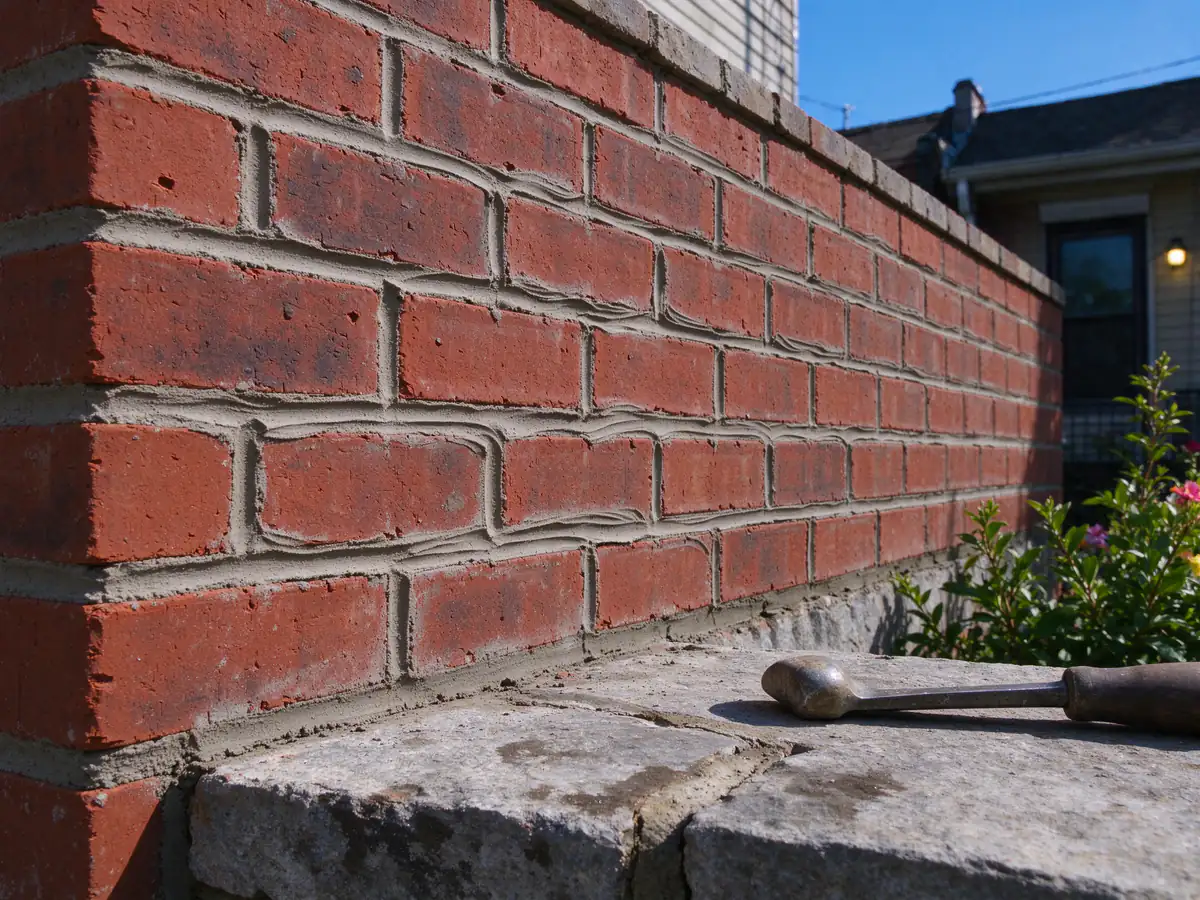
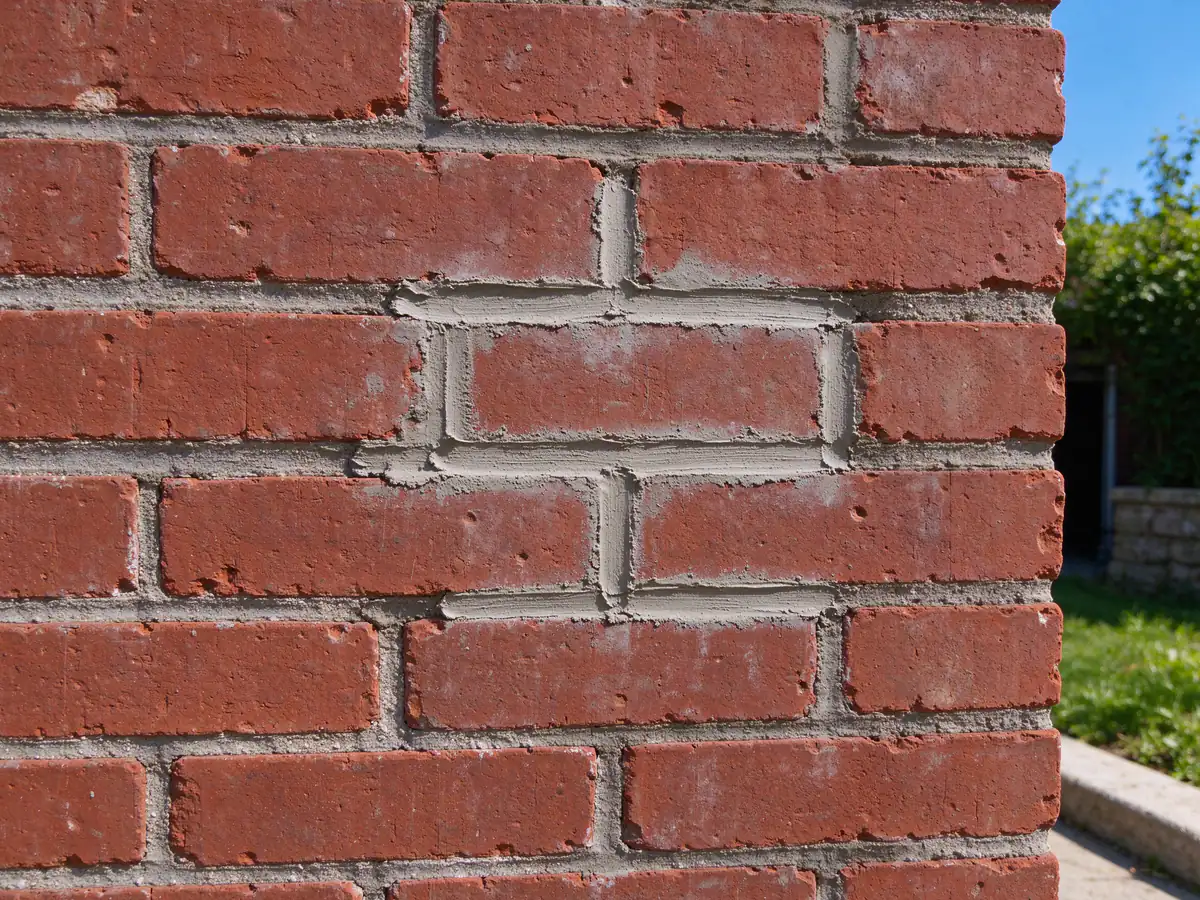
Representative photos of this type of work, not photos of specific completed jobs.