
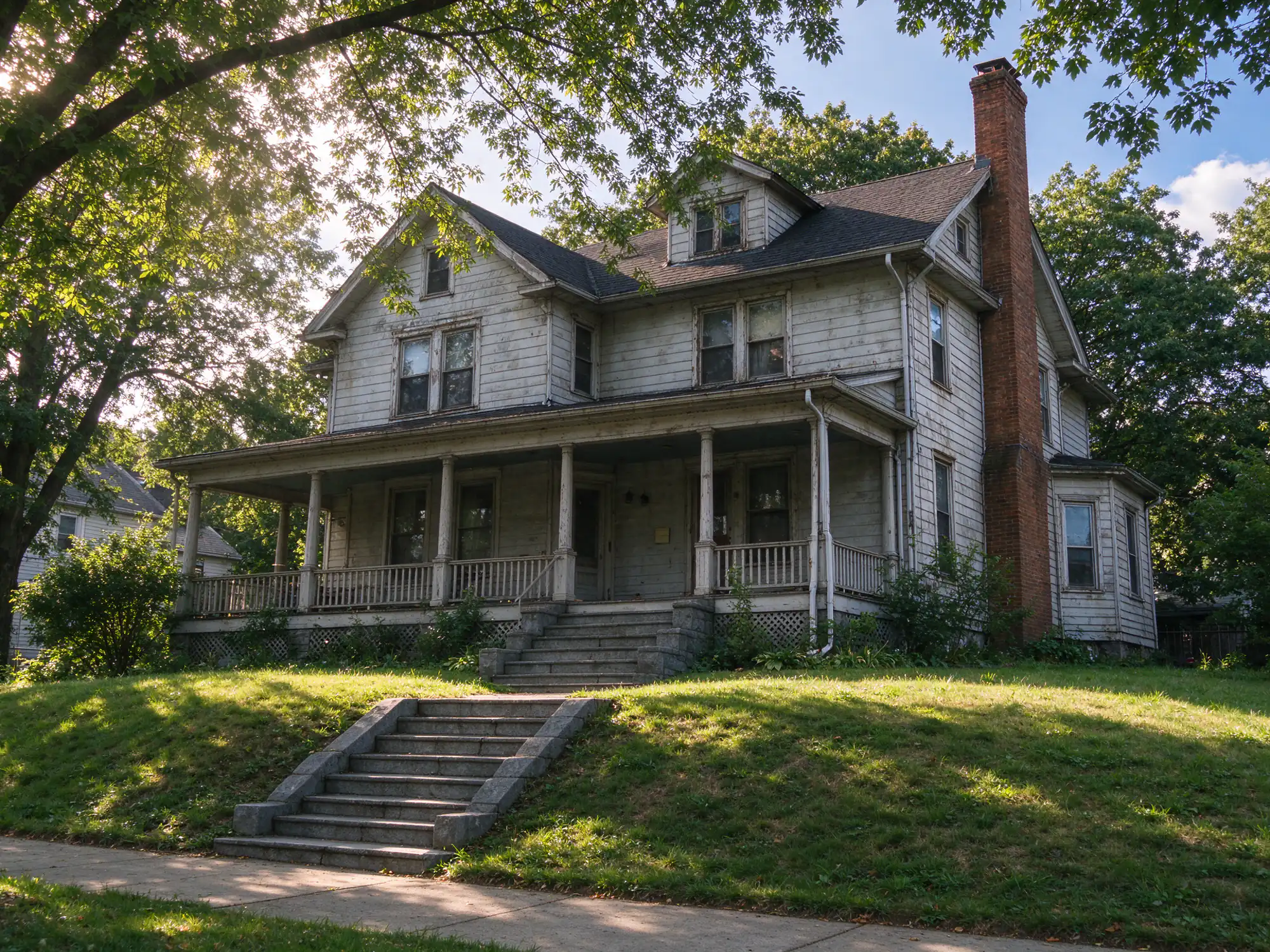
True Course Masonry Newark repairs chimneys, stone walls, front steps and brick on Montclair’s older houses, and the work is carried out by licensed and insured contractors. Montclair adds a step that most towns skip. A masonry contractor in Montclair, NJ first sorts out whether the work is something the township’s Historic Preservation Commission needs to see or a like-for-like repair that can go ahead on a permit alone. The business takes jobs of every size, from one chimney crown to restoring a street front, and the sections below explain how Montclair’s rules and its hillside ground shape that choice.
The age of Montclair’s houses
U.S. Census Bureau American Community Survey estimates for 2020 to 2024 put 59.4% of Montclair’s 16,521 housing units in buildings from 1939 or earlier, and 73.9% before 1960. Among the larger Essex County towns covered on this site, that prewar share is the highest. Just under half the units, 49.8%, are one-unit detached houses, with 19.1% in two- to four-unit buildings and 28.1% in buildings of five or more.
The survey records age, not size or material, so it cannot say how many of those houses are stone, brick or frame. What it does show is how old most of the stock is. Where a prewar house has a tall masonry chimney, stone foundation courses or a stone front walk and steps, the original mortar may be softer than anything a modern repair would default to, and the older brick home masonry guide explains why that matters before any joint is cut.
When a Montclair repair needs a Certificate of Appropriateness
The Montclair Historic Preservation Commission issues Certificates of Appropriateness under township code section 347-136 for exterior alterations to designated landmarks and to properties in local historic districts. The township’s own guidance exempts interior work, changes not visible from a public way, and like-for-like repairs that do not change exterior appearance. A Minor Application route also exists for smaller items. Which streets fall inside a district is checked per address with the township.
For masonry, the phrase “like-for-like” carries the decision. Repointing a front wall with mortar of the same color, the same joint profile and the same joint width, after cutting out only failed material, is the kind of repair the exemption describes. Widening joints with a grinder, switching to a bright gray cement mortar, coating the brick or replacing stone with a visibly different material can change appearance, and a change in appearance is what brings a project before the commission. The guide to matching mortar and brick covers how color and texture are matched, and a trial area lets everyone judge the result once cured.
Working on Montclair’s ridge slopes
Montclair sits on the east side of the First Watchung Mountain, and its western border follows that ridge from Eagle Rock to the Passaic County line. The Newark Public Library’s account of local terrain describes the land rising west of Newark toward the First and Second Watchung ridges that dominate Montclair and its neighbors. On a hillside lot, a house can stand well above its sidewalk, which tends to mean longer runs of stone or brick steps, taller stoops and foundation walls that show more on the downhill side than the uphill one.
Slope moves water, and water drives most masonry wear. NOAA’s 1991 to 2020 normals for Newark Liberty Airport, the nearest long-term station, show 46.60 inches of annual precipitation and about 65 days a year that cross the freezing mark, a proxy rather than a measured cycle count. On the uphill side of a house, runoff and wet soil can keep the lowest stone or brick courses damp for long stretches, and wet joints in freezing weather lose mortar faster. On the downhill side, steps take the runoff, and their treads see standing water and ice. A repair that does not account for where the water comes from tends to fail in the same place.
The slope also limits what is in scope. Freestanding stone garden walls, steps and the joints of stone house walls are masonry repairs; walls that hold back soil are retaining walls, which this site does not offer, and New Jersey rules require a permit for any retaining wall 4 feet or taller. Structural foundation repair is also outside scope. Where a stone foundation wall has bulged or a step run has dropped, the movement is assessed before anyone talks about repointing.
Masonry services for Montclair houses
Historic masonry restoration fits street-facing work where the like-for-like test matters, with mortar sampling, matched joint profiles and selective unit replacement. The guide to lime mortar and portland cement explains the mix choices.
Stone masonry repair covers stone foundations above grade, stone steps, garden walls and trim, judged by the stone type and how it was laid.
Chimney repair handles repointing, brick replacement and crown work on tall house chimneys. Flue liners and sweeping are not offered, and the chimney repair cost guide explains how height and access change the price.
Chimney rebuild is the route when a stack’s top courses have lost too much brick or have begun to lean, and it requires a permit.
Brick pointing means cutting failed joints out to a sound depth and repacking them, never a skim of new mortar over old.
Stoop repair covers brick and stone steps on sloped lots, where support and drainage are checked first.
How a Montclair job usually runs
A first look checks the wall type, joint depth, the condition of brick and stone, earlier repairs, water sources including grading, movement clues and access. Prices come from that visit, and the written scope names each area, the method and the access, along with the mortar and joint profile proposed for street-facing work.
Permits go through Montclair’s own construction office. Under N.J.A.C. 5:23-2.14, repair or reconstruction needs a permit unless an exception applies, and the state ordinary-maintenance list contains no repointing item. Where the address is a landmark or sits in a local historic district, the like-for-like question is settled with the township at the same time. The NJ DCA Construction Reporter shows $0 in residential alteration value for Montclair in 2024, which looks like a reporting gap rather than a lack of work, so it says nothing about local demand.
Surfaces are protected, failed material is removed to sound limits with dust control, and a trial area is laid where color matters. Work is cured and protected, then cleaned up and walked through. New Jersey law requires any home improvement contract over $500 to be in writing with the contractor’s registration number and insurance certificate; the guide to hiring a masonry contractor in New Jersey covers the rest.
Neighboring towns have their own pages: Glen Ridge, Bloomfield and Orange.