
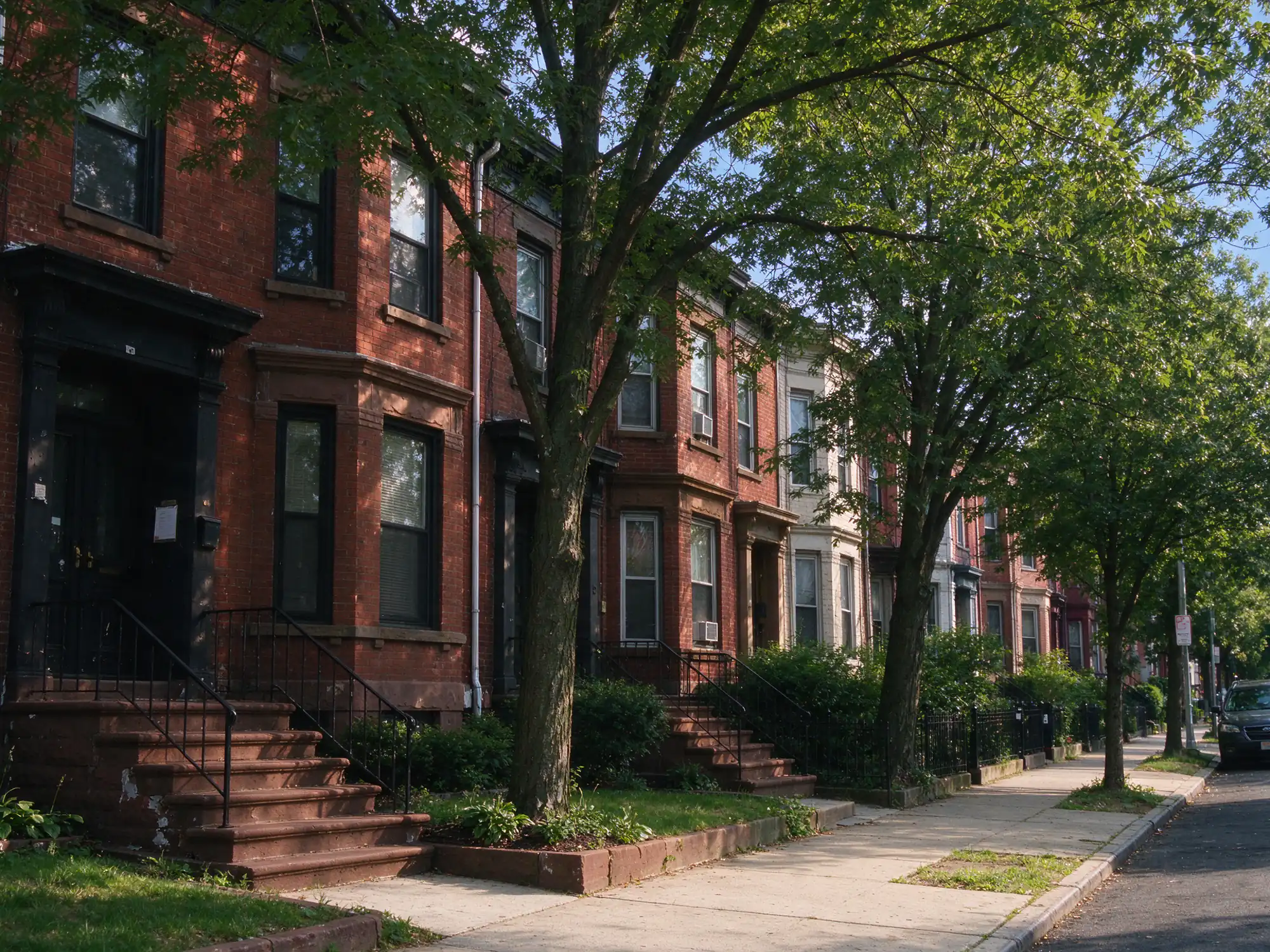
True Course Masonry Newark repairs brownstone, other stone and brick on Belleville houses, two-family homes and older commercial buildings, with the work carried out by licensed and insured contractors. For a masonry contractor in Belleville, NJ, a stone front raises a specific question: whether a worn or cracked piece can be saved, and what a new one would have to match. The business takes jobs of every size, from one stone step reset to repointing a whole front. Belleville’s answer to that question is shaped by its own geology and history, which is where this page starts.
Stone with a Belleville address
Belleville took its original name, Second River, from the stream that forms much of its border with Newark as it runs through Branch Brook Park, part of which lies inside the township. That stream valley is also a quarry story. The NJ Geological Survey’s 2012 circular on New Jersey brownstone says the quarries in the Passaic Formation near Newark, the Belleville quarries, were the most productive source of brownstone-front stone in the country, and a 1973 Belleville Times article places the earliest quarries along the Second River in the 1700s. Many Newark-area quarries had closed by the mid-1800s, and none has supplied stone commercially for over a century.
The housing stock is old enough for that heritage to matter. U.S. Census Bureau American Community Survey estimates for 2020 to 2024 show 61.2% of Belleville’s 15,104 housing units built before 1960 and 32.4% in 1939 or earlier. The form is mixed: 42.2% one-unit detached, 28.1% in two- to four-unit buildings, 22.8% in buildings of five or more and 6.5% one-unit attached. No source counts how many of those buildings carry brownstone, so the question is asked house by house. Where a front, sill, lintel or step is red-brown sandstone, though, it is a soft, layered stone with no local source for replacements, and that changes how a repair is planned.
How a Belleville job usually runs
A first look checks what the wall is made of where that can be seen, the depth and condition of the joints, the state of the stone and brick faces, earlier repairs, likely water sources, movement clues and access. On stone, it also notes whether faces are flaking in layers, which points to how the stone was set and how wet it stays. Prices come from that visit, and a written scope lists the areas, the method for each and the access needed.
Belleville permits are issued by Belleville’s own construction office, separate from Newark’s even where the two towns meet at the Second River. Under N.J.A.C. 5:23-2.14 a repair or reconstruction needs a permit unless an exception applies. The ordinary-maintenance list in 5:23-2.7 contains no masonry or repointing item, though it does cover repairing part of a stoop that does not support a roof with identical or closely similar materials in the same place. This research did not find a local historic commission in Belleville, so whether any street-facing work needs review is confirmed with the township along with the permit question.
During the work, adjacent surfaces are protected, failed mortar and unsound stone are removed only to sound limits with dust control, and a trial area is laid where color matters. Work is cured and protected from weather, and the job closes with cleanup and a walkthrough. A written contract is required by N.J.S.A. 56:8-151 for any home improvement over $500, with the contractor’s registration number and insurance certificate attached.
Why soft stone changes the repair
Brownstone is a sedimentary sandstone, laid down in layers, and that layering governs how it weathers. Where a block was set with those layers standing on edge, parallel to the face, water that soaks in and freezes can push the outer layers off in sheets. NOAA’s 1991 to 2020 normals for Newark Liberty Airport show about 65 days a year that dip below freezing and rise above it again, a proxy rather than a cycle count, and 46.60 inches of annual precipitation. A stone that stays wet through those swings loses its face faster than one that dries out between rains, and the guide to why brick and stone spall explains that mechanism in more detail.
The mortar around soft stone matters as much as the stone. National Park Service Preservation Brief 2 sets out the principle that repointing mortar should be no harder and no less permeable than the masonry it joins, so that the joint, not the unit, takes the wear and lets moisture out. A dense cement mortar or a cement patch on brownstone can do the opposite and push water and salts through the stone around it. The guide to lime mortar and portland cement covers how a mix is chosen, and the guide to matching mortar and brick covers color and texture.
Matching is the last constraint. With no Belleville stone available, a missing piece can be rebuilt with a compatible patching material, cut in as a new piece of similar stone, or replaced with sound stone salvaged from a less visible spot. Each looks different once weathered, which is why the guide to brownstone repair and matching treats the choice as a trade between durability and appearance rather than a single right answer.
Services that fit Belleville’s mix of buildings
Stone masonry repair covers brownstone and other stone fronts, sills, lintels and steps: repointing stone joints, resetting loose pieces and replacing units that cannot be saved.
Historic masonry restoration applies where an older front is worth keeping as it is, with mortar sampling, matched joint profiles and selective replacement instead of wholesale renewal.
Brick pointing handles the brick walls of detached houses and two- to four-family buildings, cutting failed joints out to a sound depth before repacking them.
Stoop repair covers brick and stone steps, where support and drainage under the treads are checked before the joints.
Brick repair replaces spalled or cracked units, matching size and color to the wall around them.
Chimney repair covers repointing, brick replacement and crown work on house chimneys. Flue liners and sweeping are not offered.
Owners on the Newark side of the Second River can read the Forest Hill page, and neighbors to the west and south can see Bloomfield and East Orange.