
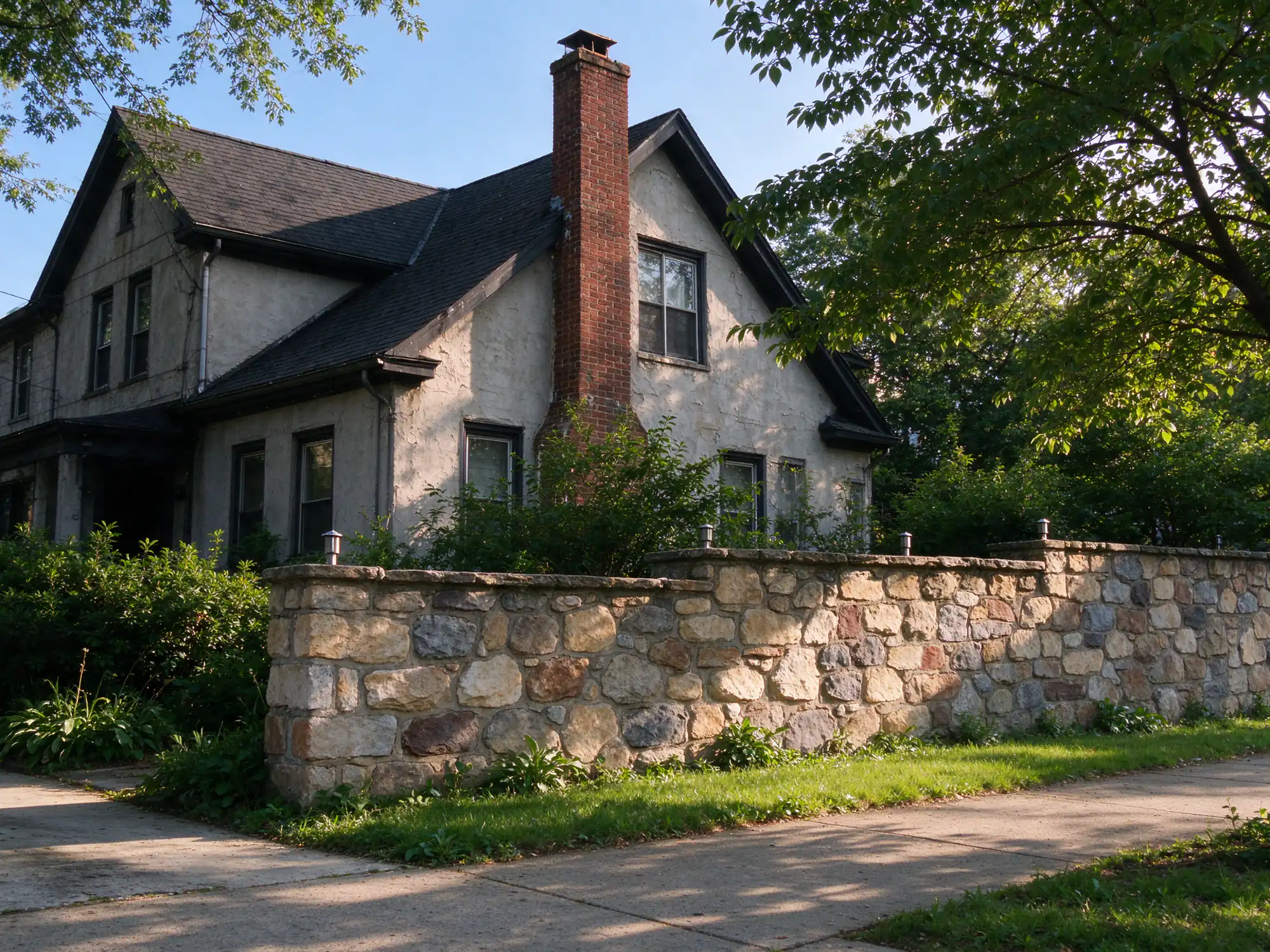
True Course Masonry Newark repairs chimneys, stone walls and brick on older Maplewood houses. Before cost comes up, a masonry contractor in Maplewood, NJ has to answer a township question: is the repair ordinary like-for-like work, or a visible change that may need local historic review? The work is fulfilled by licensed and insured contractors, and the business takes masonry jobs of every size, from repointing one chimney to resetting a few loose stones at a front step.
Is your Maplewood repair like-for-like or a visible change?
Most chimney and stone jobs on a prewar Maplewood house start as like-for-like repair: open joints raked out and repointed, a cracked crown replaced, a spalled brick swapped. Those can change the look of a house more than owners expect, because new mortar in the wrong color or a wider, smeared joint reads clearly from the street. A rebuild that changes a chimney’s height, shape or brick is a visible change by any measure.
The distinction matters in Maplewood because the township has two layers of historic recognition. The Maplewood Historic District was listed on the National Register in 1997 with 432 contributing structures, and the Maplewood Historic Preservation Commission was created by Ordinance #2166-01 on July 3, 2001. This research did not confirm which exterior masonry tasks the commission reviews, so street-visible chimney and stone work on an older house is checked with the township before the scope is settled rather than after.
Services that fit older Maplewood houses
Chimney repair covers repointing the stack, replacing damaged brick and crown work. Where a stack leans or has lost much of its brick above the roof, chimney rebuild is the scope instead, and the guide to rebuild or repoint decisions explains how that line is drawn. Flue liners and sweeping are not offered.
Stone masonry repair applies where a house has a stone foundation, stone steps or a stone garden wall. Sandstone, fieldstone and granite do not behave alike, so the stone type is identified before any mortar or patch is proposed.
Historic masonry restoration brings in mortar matching, joint-profile matching and selective unit replacement where appearance carries extra weight. The guide to lime mortar and portland cement covers why a harder mix is not automatically a better one on old masonry.
Brick pointing and stoop repair cover the rest of the envelope, from a brick side wall to front steps that have settled.
How a Maplewood job is scoped
A first look checks the wall or stack type wherever it can be seen, joint depth and brick or stone condition, earlier repairs, water sources, movement clues and access. On a chimney, it also notes the crown, the flashing where the stack meets the roof and any lean, since a leak at the ceiling can come from flashing rather than masonry; the guide to chimney leaks sets out how to tell the two apart. Where color matters, a trial area of mortar is made and left to cure before the main work so the match can be judged dry.
Permits run through Maplewood’s own construction office. N.J.A.C. 5:23-2.14 requires a permit to repair or reconstruct a structure unless an exception applies, and a chimney rebuild counts as reconstruction. New Jersey’s 2024 code editions took effect on August 17, 2026, with a reported grace period. Smaller jobs are confirmed with the Maplewood office for the address.
Why older Maplewood masonry needs a gentler hand
Age is the defining local fact. U.S. Census Bureau American Community Survey figures for 2020 to 2024 show 55.5% of Maplewood’s 9,051 housing units were built in 1939 or earlier and 71.4% before 1960, against 23.7% built before 1940 in Newark. Houses of that age were commonly laid in softer, more lime-rich mortar than today’s bagged mixes, and where that is true, repointing with a much harder mortar can shift water and stress into the brick or stone so that the units, not the joints, start to fail.
The house form is the second fact. With 60.9% of units detached, most Maplewood masonry belongs to single houses, and each one has a chimney stack exposed on four sides above the roof. NOAA’s 1991 to 2020 normals for Newark Liberty Airport, the nearest long-term station, record 46.60 inches of precipitation a year and about 65 days on which the low falls to freezing while the high climbs above it, a proxy rather than a measured cycle count. A crown with open cracks lets that water into the top of the stack, where those crossings act on it; the guide to chimney crown cracks explains what each crack pattern can mean.
Terrain is the third. The Newark Public Library describes the red sandstone ridges of First and Second Mountains rising west of Newark, with the South Orange and Maplewood edge among the areas they dominate. Where a lot slopes, front steps run taller and water moves across the yard toward the house, which affects stone steps and walls near grade. Retaining walls themselves are not offered.
Why this approach suits Maplewood houses
Scopes are written around what the house actually has, so a sound chimney with a cracked crown gets a crown, not a rebuild. Small repairs are taken as readily as large ones, and New Jersey law requires home improvement contracts over $500 to be in writing with the contractor’s registration number and insurance certificate. Owners near the township line can also see the Irvington and Orange pages.