
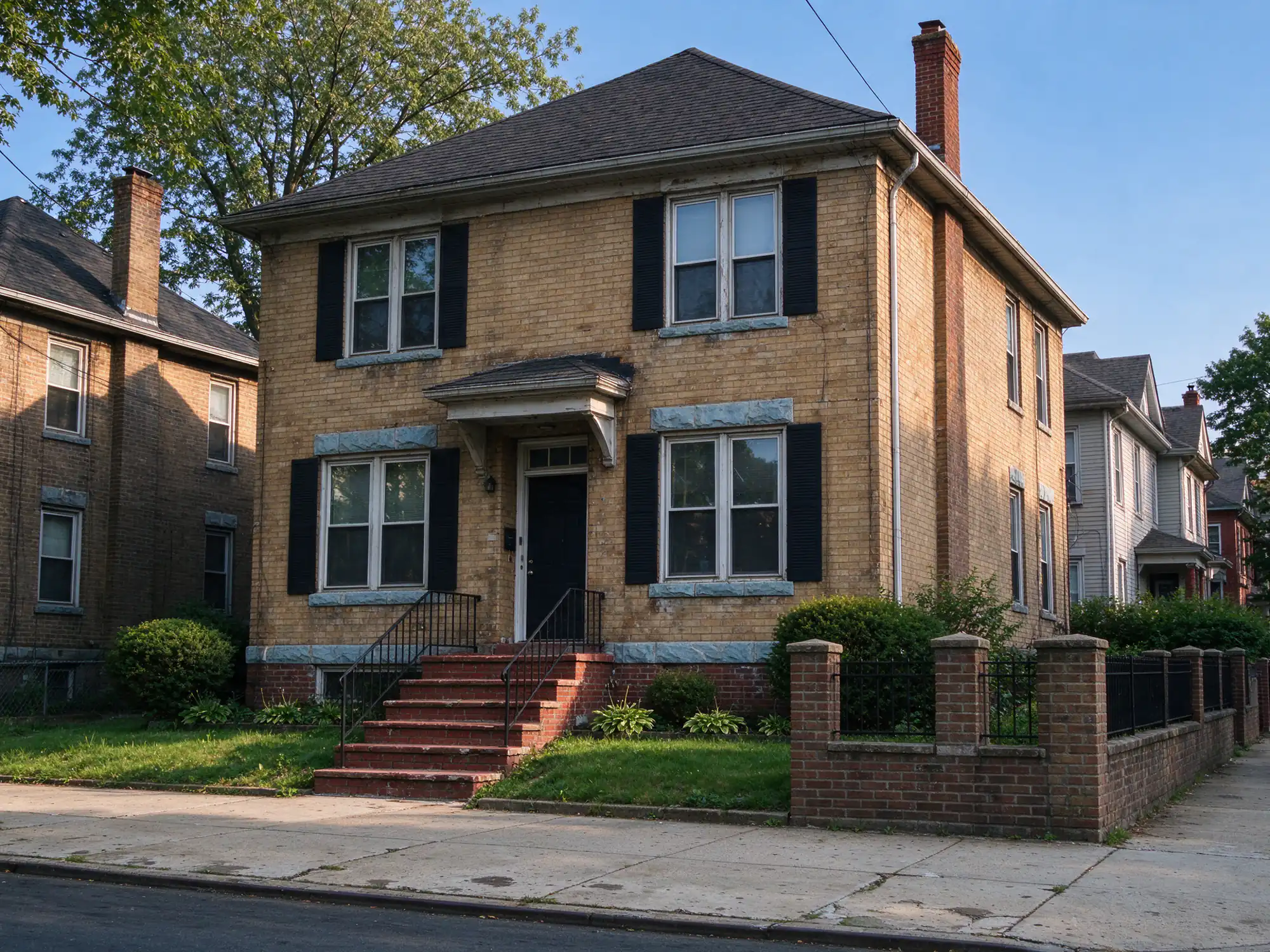
True Course Masonry Newark repairs brick, stoops, chimneys and foundations in Kearny, through licensed and insured contractors and on jobs of every size, just across the Passaic from Newark. Kearny is a prewar two-family town. American Community Survey figures for 2020 to 2024 show 42.3% of its housing units in buildings of two to four units, 26.5% in two-unit buildings alone, with 38.2% built in 1939 or earlier and 61.7% before 1960. Much of its older masonry is hard brick with stone trim, and repairs have to match it.
Old hard brick, thin joints and stone trim
Kearny grew quickly from the 1870s, when the Clark Thread and Nairn Linoleum works drew thousands of Scottish and Irish workers, and much of the housing dates from that growth and the decades after. The town’s best documented building from the period is Highland Hose No. 4 on Halstead Street, built in 1894 and 1895 and listed on the National Register in 1987. Its nomination describes smooth, hard-burned clay brick set in thin mortar joints, bluestone bases and sills, segmental brick arches over the openings and a rubble stone foundation about twelve inches thick.
That combination shows what to look for on an older Kearny wall. Hard, smooth brick sheds water off its face and pushes it toward the joints, so the mortar, not the brick, is where the wall wears. Thin joints need narrow tools and care at the brick edges when they are cut out, and refilling them to the original width keeps the wall looking like itself. Bluestone sills and bases are a different material again, laid in layers, and are repaired as stone rather than patched like brick. The guide to matching mortar and brick and the guide to tuckpointing versus repointing explain what a careful joint repair involves.
No Kearny historic preservation commission or local designation was found, so no review stands between an owner and an unsuitable repair. Matching is the owner’s choice, and it is worth making.
Services for Kearny houses
Brick pointing covers joints on walls, chimneys and foundations, and the guide to when to repoint sets out the signs. Brick repair replaces spalled and cracked units. Stoop repair handles the brick and stone front steps that serve both units of many two-family houses, and chimney repair covers stacks and crowns, with flue liners and sweeping not offered.
Stone masonry repair covers bluestone sills and caps and old stone foundations, and masonry repair is the starting point when it is not yet clear which part of a wall is failing.
Two-family houses: one stoop, one chimney, two households
On a two-family house, the masonry is shared even when the units are not. One front stoop often leads to both entries, one chimney may serve two heating systems, and one foundation carries both floors. A rocking tread or a gap at the top step is under everyone’s feet in the building, so it is worth fixing before it becomes a trip or a fall rather than waiting for a larger job.
Chimneys on these houses work hard. A stack that vents two boilers or furnaces sees more heat and more moisture from combustion than a single-family chimney, and the crown and the top courses of brick take the worst of the weather. Cracked crowns, loose top brick and open joints are the usual first repairs. The liner and the flue itself are a chimney specialist’s work and are not offered, so where a heating replacement raises questions about the flue, that part goes to a specialist.
Sandy and Kearny’s low-lying blocks
Hurricane Sandy reached Kearny houses as well as the Meadowlands. Kearny’s mayor told The Observer in November 2012 that most houses in the East Midland section flooded as the tidal surge came up through the sewer lines, and pump stations at East Midland Avenue, Quincy Place, John Hay Avenue, Sellers Street and Harrison Avenue flooded and failed. The town’s emergency management office later estimated about 150 homes and 50 apartments were damaged. Route 7, the Belleville Turnpike, is described by the state as frequently flooded because of its low elevation.
Basement brick that sat in surge water carries salt and moisture long after the water drains. The salt crystallizes at the surface as the wall dries, the powdery deposit covered in the guide to efflorescence, and the lowest courses, wettest for longest, are where weak mortar gives out first. For houses on low blocks, the first look notes how high water has reached before and whether the wall is dry enough to repoint, since mortar packed into a saturated wall cures poorly. FEMA’s flood maps show which properties sit in high-risk zones, and the address is worth checking there.
How a Kearny job is planned
The first visit notes the brick type and joint width, the stone trim, the condition and color of the old mortar, earlier repairs, where water reaches the wall and any movement, plus which household uses the affected entry or windows. NOAA’s 1991 to 2020 normals for nearby Newark Liberty Airport record about 65 days a year when the low falls to freezing and the high climbs above it. Water left in an open joint or under a loose tread goes through each of those crossings, which is why fall is the season to close them.
Permits come from Kearny’s Construction Code Enforcement Department. N.J.A.C. 5:23-2.14 requires a permit to repair or reconstruct a structure unless an exception applies, and New Jersey requires home improvement contracts over $500 to be in writing with the contractor’s registration number. Owners nearby can also see the Harrison, Ironbound and Belleville pages.