
Last Updated:
Historic masonry restoration in Newark, NJ is repair work held to one test: does it let the old wall keep working the way it was built to? True Course Masonry Newark restores older brick, brownstone and stone masonry across Newark and Essex County, from a rowhouse front in a historic district to the side wall of a pre-war three-family house, with the work carried out by licensed and insured contractors. Small restoration jobs are welcome too, such as one sill or a band of joints under a cornice. Restoration keeps original material wherever it can be saved, repairs it with materials that are softer and more breathable than the brick or stone, and replaces only what cannot stay. That approach matters here because so much of the city is old. U.S. Census Bureau American Community Survey estimates for 2020 to 2024 count about 23.7 percent of Newark’s housing units as built in 1939 or earlier. The guide to lime mortar vs portland cement explains the core material choice in more depth.
What happens on the first visit
A first look at an older building is about learning how the wall was built and what has already been done to it, before anyone picks a mortar. The visit checks:
- Wall type. Whether the wall is solid masonry several units thick or a veneer, which changes how it handles water. Header rows in the brick are one clue; the older brick home masonry guide explains others.
- The existing mortar. Its color, the sand in it, how hard it is and how deep it has eroded, and whether a sample should go for analysis.
- The units. Soft or hard brick, brownstone peeling in layers, carved or molded details and how much original material survives.
- Earlier repairs. Hard gray cement in old joints, smeared pointing, coatings and patches, which are often part of the damage.
- Water sources. Cornices, parapets, gutters, sills, stoops and the base of the wall, since restoration under a steady leak does not last.
- Movement. Cracks through units, bulges and gaps at openings, which call for a different repair and sometimes an engineer.
- Review. Whether the building is in a historic district or is a landmark, which affects materials and timing.
Please do not probe loose masonry or stand under a cornice or parapet that looks displaced.
Lime mortar and compatibility
Old masonry was usually laid in mortar much softer than modern cement mixes. That was not a weakness. A soft, breathable joint lets water leave the wall through the mortar, and when the wall moves or freezes, the joint gives first. The mortar is the part of the wall meant to wear out and be replaced.
Repointing an old wall with a hard, dense, cement-rich mortar reverses that. The new joint becomes stronger and less permeable than the brick around it, so moisture and salts exit through the brick face instead, and stress concentrates in the brick edges. The faces start to spall while the hard joints stand proud. National Park Service Preservation Brief 2, the federal guidance on repointing historic masonry, puts compatibility at the center: the repair mortar should match the old in color, texture and tooling, and be no harder or less permeable than the masonry it sits in. The guide to why brick spalls shows how that damage develops.
Compatibility is not the same as one universal recipe. Some old walls suit a lime-rich mix; others, especially those already repaired with cement, need a blend chosen to work with what is now in the wall. A good restoration scope names the mix after the brick, the exposure and the existing mortar are understood, not before.
Mortar analysis, sample panels and gentle cleaning
Mortar analysis. On significant work, samples of the original mortar can go to a laboratory to identify the binder and the sand. That gives the new mix a real starting point. Without analysis, nobody can honestly claim to have matched the original mortar exactly; a careful match from samples is a match in appearance and behavior, and it should be described that way.
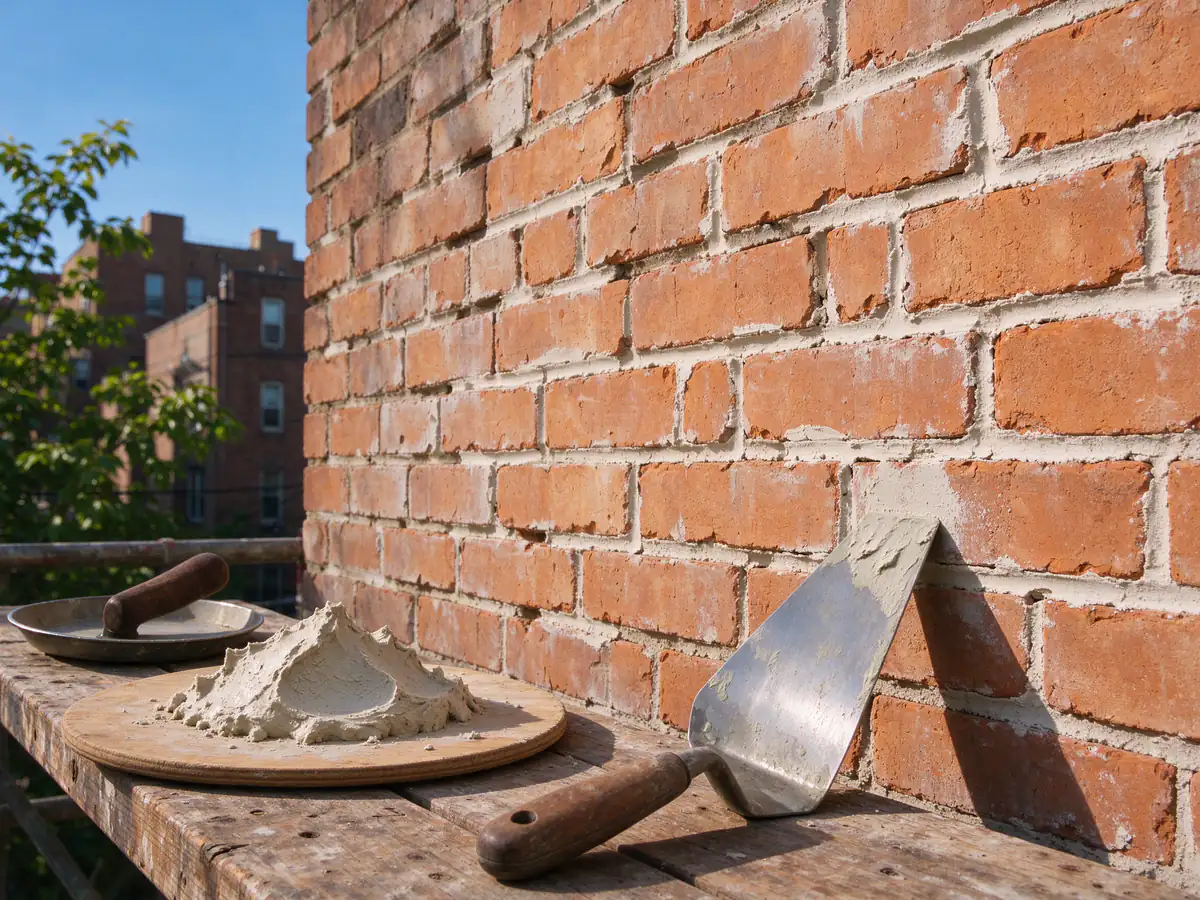
Sample panels. Before a whole front is pointed, small trial areas are mixed and placed in an inconspicuous spot, then left to cure. Fresh mortar dries lighter or darker than it looks wet, so color is judged only after curing, in daylight, next to the old joints. Panels also test the joint profile: flush, slightly recessed, concave or struck. A profile that differs from the old one makes even a perfectly colored mortar read as a patch. The guide to matching mortar and brick covers this in more detail.
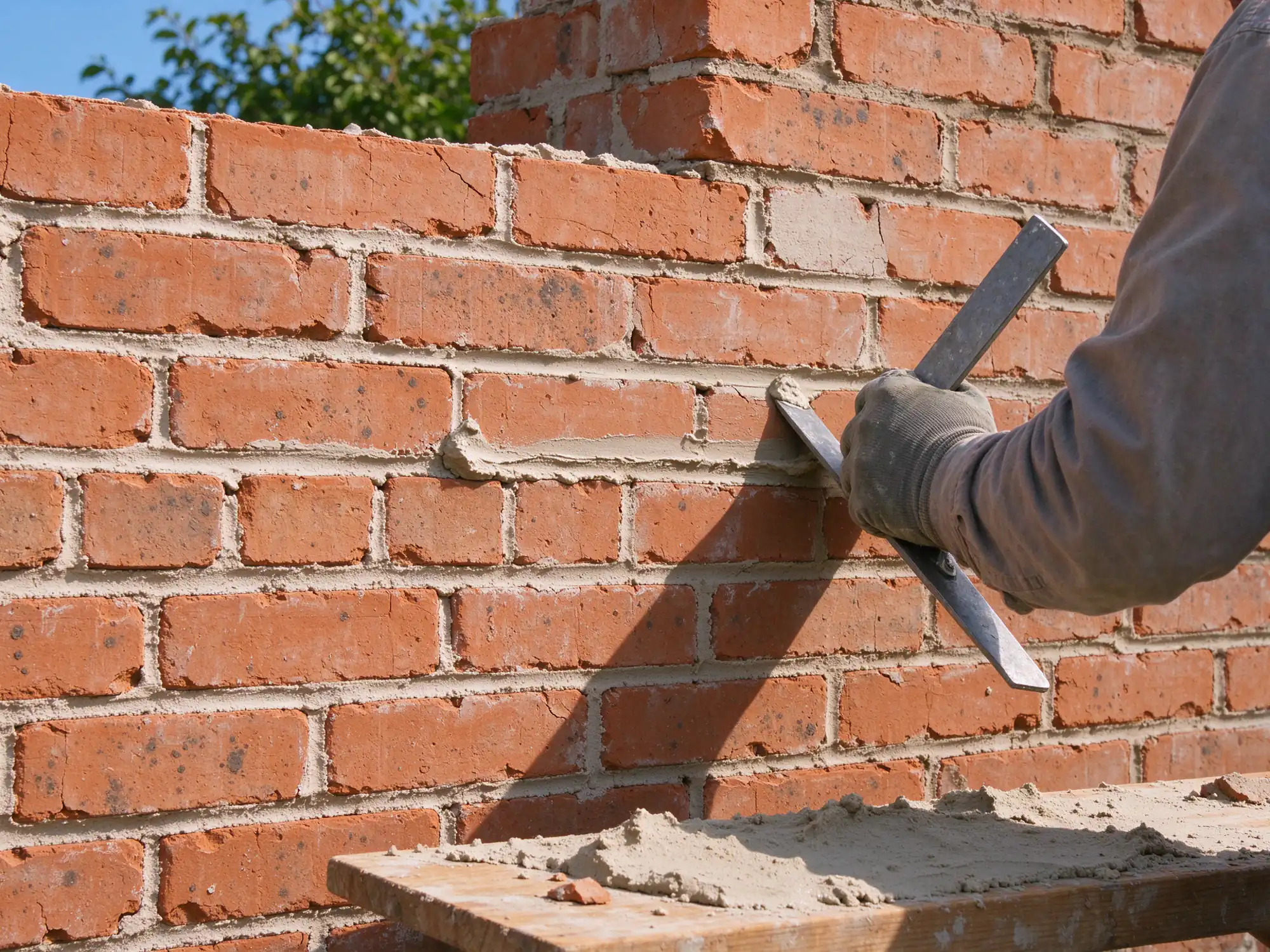
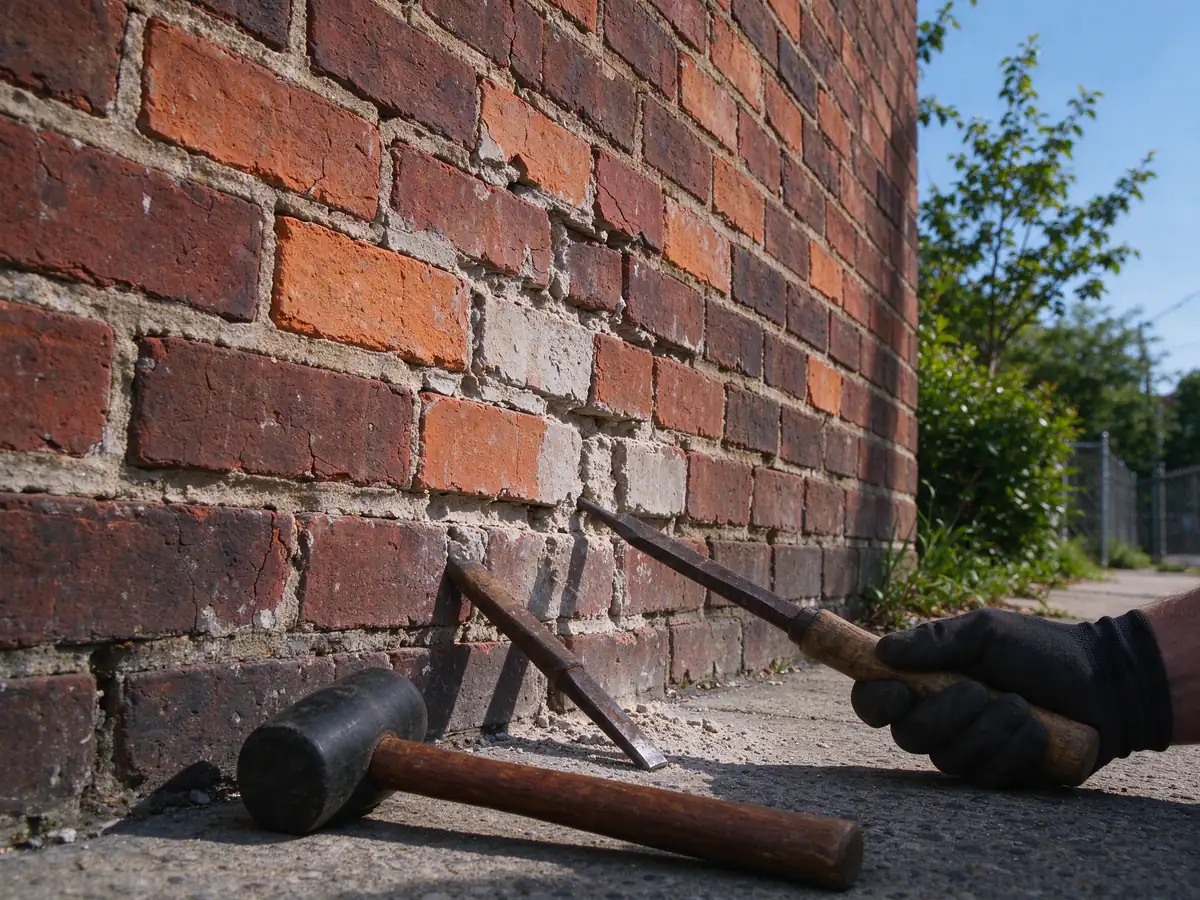
Cutting and repointing. Preservation Brief 2 recommends removing old mortar to a depth of at least 2 to 2.5 times the joint width, filling deep joints in layers of about a quarter inch, and working when wall temperatures sit between about 40 and 95 degrees F. It also favors hand chisels on soft historic brick, with grinders used only with care. The brick pointing page describes the full process.
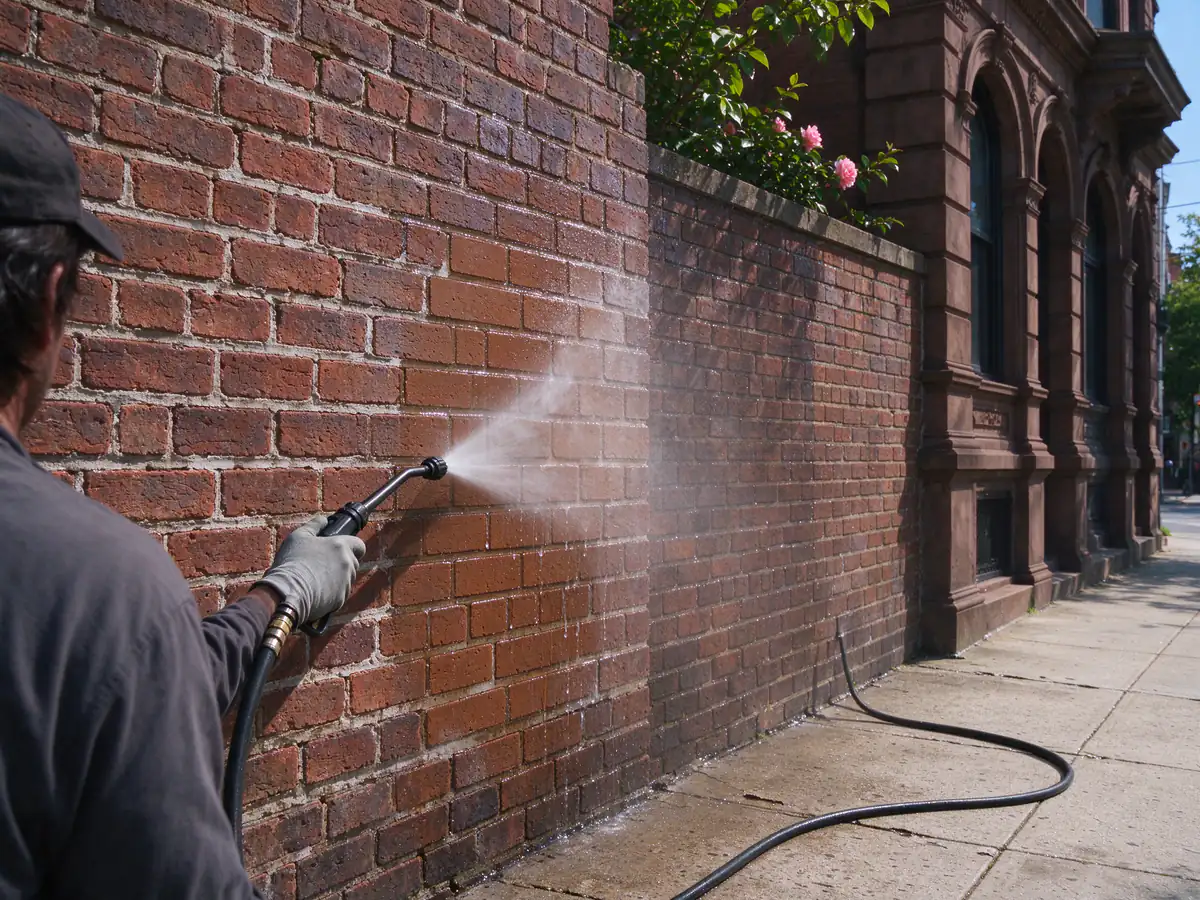
Gentle cleaning. Old brick and brownstone are easily damaged by sandblasting, high-pressure water and strong acids, and the damage often shows only after the next winter. Cleaning uses the gentlest method that works: low-pressure water, soft brushes and cleaners matched to the material, each tried on a small patch first. The guide to cleaning masonry without damage explains why, and the guide on whether to seal brick covers the coatings question that often follows.
Matching brick and stone. Where units cannot be saved, replacements are chosen for size, color, texture and hardness, and salvaged brick can help on a visible front. Brownstone has not been commercially quarried in Newark or Belleville for more than a century, so stone repairs lean on patching, dutchman inserts and substitute or salvaged sandstone, which the stone and brownstone masonry repair page and the brownstone repair and matching guide cover.
Restoration or reconstruction
Restoration repairs in place. Reconstruction takes a section down and builds it again. Reconstruction is the right choice when a section has bulged, moved or lost so much material that it cannot stay up or stay dry without it, and in that case the coursing, bond pattern and details are recorded before anything comes down so the rebuilt section can follow them. Sound original units that come out whole go back into the wall. Single damaged bricks on a sound wall are a smaller job, covered on the brick repair and replacement page. Homeowners report that what started as a routine front restoration grew once the wall was opened, because rusted steel, voids or loose backup masonry behind the face only showed then. A sound scope says what is assumed about hidden conditions and how changes are approved in writing.
Historic review, permits and access
Newark’s Landmarks and Historic Preservation regulations, Chapter 41:10 of the municipal code adopted in 2023, give the Landmarks and Historic Preservation Commission power to issue Certificates of Appropriateness for work in historic districts and on landmarks. A Historic Preservation Officer may issue a Certificate of No Effect for work judged not detrimental. Newark’s designated districts include Forest Hill, Four Corners, James Street Commons, Lincoln Park, Military Park Commons, North Broad Street and Weequahic Park. Which masonry tasks are exempt from review has not been confirmed, so street-facing work in a district should be raised with the city early. Homes in Forest Hill are a common case.
Nearby towns run their own commissions. In Glen Ridge, exterior changes that need a building permit and can be seen from a street go before the Historic Preservation Commission, and its guidelines include a masonry chapter. Montclair issues Certificates of Appropriateness for landmarks and local districts, with like-for-like repairs that do not change appearance listed as exempt. Maplewood has had a Historic Preservation Commission since 2001.
Commission review sits alongside the state construction code, not in place of it. N.J.A.C. 5:23-2.14 requires a permit before repair or alteration except for ordinary maintenance, minor work and emergency work, and the ordinary maintenance list does not name masonry repointing. The guide to masonry permits in Newark covers what to ask. Scaffolding over a public sidewalk needs bridging designed by a design professional under N.J.A.C. 5:23-2.34.
What shapes the cost of restoration work
Historic restoration is priced from a site visit, because published cost data for this work is too thin to give a dependable range. One add-on does have a national figure: HomeGuide’s February 2026 guide lists laboratory mortar composition analysis at about $300 to $500 per test. That is a national figure, not a local rate. The rest of the price moves with:
- how much original material can be kept and repaired
- the share of joints to cut out, and how carefully soft units must be handled
- mortar analysis, custom mixes and trial panels
- matching or salvaged brick, replacement or patched stone, and dutchman work
- cleaning method, testing and protection
- height, scaffold and sidewalk bridging
- commission review, permits and the time those take
Owner-occupied homes do not qualify for the federal 20 percent historic rehabilitation tax credit, which is limited to income-producing buildings. The guide on hiring a masonry contractor in NJ explains what a written New Jersey home improvement contract must include. The list below shows what a restoration scope from True Course Masonry Newark covers.
What's included
- A look at the brick or stone, the existing mortar, earlier repairs and the water sources before a restoration scope is priced
- A written scope that names each area, the repair method for each and what will be kept, repaired or replaced
- Mortar sampling, and laboratory analysis where the project calls for it
- Protection for windows, ironwork, doors, plantings and neighboring property
- Removal of failed mortar and incompatible repairs to sound material, with dust control and hand tools on soft units
- Cured trial panels for mortar color, texture and joint profile, reviewed before full work starts
- Selective unit repair or replacement with matched or salvaged material
- Curing protection, a tested cleaning method and a final walk of the finished work
Restoration compared with reconstruction on an older masonry front
| Restoration | Reconstruction | |
|---|---|---|
| Aim | Keep as much original brick, stone and detail as possible and repair it in a compatible way | Take down a failed section and build it again, reusing sound original units where they come out whole |
| When it fits | Mortar, faces and details are worn or damaged but the wall is in plane and stable | The section has moved, bulged or lost so much material that it cannot stay up or stay dry if repaired in place |
| Typical work | Repointing, patching, dutchman repairs, selective unit replacement, gentle cleaning | Documenting coursing and bond, dismantling, correcting the cause, relaying with compatible mortar |
| Review in a district | Street-facing work can still need commission review, mainly for mortar color, joint profile and materials | More likely to need review of materials and methods before work starts |
Related resources
- Decision GuideLime Mortar or Portland Cement: Which Is Right for an Old Brick Wall?
- Decision GuideDo You Need a Permit for Masonry Work in Newark, NJ?
- LearnHow Is Brownstone Repaired and Matched?
- LearnHow Do You Clean Brick Without Damaging It?
Representative photos of this work
Representative photos of this type of work, not photos of specific completed jobs.